For a feminism of sisters of the land (2024)

It is March again. After an almost non-existent winter with high temperatures caused by the climate emergency, it’s time again to raise our voices and share our stories.

This year we have to start by talking about Palestine, a land that has been sacked for decades, and where Israel is now carrying out genocide. Gaza’s civilian population is falling victim to bombings, famine and disease. This is how you destroy a people, denying land access and food sovereignty. What is happening to Palestine is heartbreaking. It is unbearable to see daily images of a genocide unfolding and to go on with our daily lives. From our towns and villages, we demand a ceasefire and freedom for Palestine.

This is for the Palestinian women who resist and fight the occupation, while doing their best to look after their families and their communities. They continue trying to get any food and water they can. They continue protecting, surviving and providing shelter in this war that’s been declared against land and life.

Sisters of the land,

These are turbulent times, with tractor protests on the roads. Sectors of the countryside have taken to the streets. These protests rebel against the urban, paternalistic, condescending perspective of the countryside. A perspective and way of talking about us that pigeon-holes us as one type of countryside and one story. Of course, we know the real interests behind this communication strategy and the confusion it generates is a real concern. What are they demanding? Who’s doing it? Who can do it? From what positions? In the French movement Les Soulèvements de la Terre’s manifesto in defence of the land, we read that ecology must be a peasant’s ecology for the people. We would add that our countryside, the one we’re building, must be an agroecological countryside for the people. One that’s made up of peasants, not agroindustry. It is time for a change of model, for one that prioritises life, land conservation and biodiversity. One that provides us with healthy food and doesn’t make us sick. One in which all workers can access decent living conditions. We truly believe that only agroecology has room for all of us. In this proposal the territory as a whole works in a synchronised way, respecting the limits of our natural resources. It builds an emotional, sociocultural and economic network through the food that we grow and consume; through the gratitude and mutual care shown by those who provide food and those who receive it. We’re done with the hate speeches that identify our equals as enemies, leaving us with no energy to fight the system that pits us against each other. We are all sisters. Through respect, honesty and mutual support we can build a living and diverse rural area for all of us. We should ask ourselves how we would like to be fed and remember the names, stories and lives behind a plate of food. Those whose work allows us to eat must be given back their dignity. We live in a system in which food is thrown away as if it’s rubbish, in which grocery shopping is done automatically, without any thought of what is behind each item we put in our baskets. Of course we don’t want to place blame. We know what kind of food reaches the supermarkets, about the time you have to invest to shop and cook in a conscious way. We know that the system we live in breeds precarity and exhaustion. We demand the right to imagination. We don’t want to stop imagining and desire better worlds. A type of desire that goes far beyond consuming (always more, always immediately). We want discourses that sow hope, that break the moral superiority associated with academia and centres.

Sisters of the land,

We’re still here, those of us who can’t take to the streets or protest. We’re still here, those of us who are bedbound or can’t leave the house. Those of us who are excluded and discriminated against for feeling, speaking or doing differently. We’re still here, those of us who are rejected for having a psychiatric diagnosis, those of us who earn less for doing the same job because of a disability. We’re still here those of us who are abused in cruel and perverse relationships. We’re still invisibilised despite our years of learning. ALL of us are still belittled for not conforming to the mandates of a machista, ableist, sanist, and ageist society.

And with this diversity, we’ll keep enriching territories with our strengths and vulnerabilities, building other ways of inhabiting, sharing and living.

Sisters of the land,

Let’s not forget all the migrant women who do seasonal work in the factories, fields and greenhouses. Those who get paid according to where they’re from, who aren’t allowed to talk while working, and who, if there’s no production, aren’t guaranteed their contracted hours or pay. On top of all of this, women who work sorting, discarding and storing fruit in summer have to work in refrigerated conditions to ensure the quality of the fruit. And the variable hours and night shifts, make it tricky to balance work and family life, especially as in summer the schools are closed.

Sisters of the land,

We want to add some joy to this manifesto. Let us mention with pride, the women in our towns who always stop in the street to chat and bring out chairs to enjoy the fresh evenings. They share their meals and firesides, and are always there building the community. We want a dignified life for all, to feel joyful and lucky to live where we live. This is for all the women who want to know who’s living in their village and who respect everyone for who they are. There’s no time for judgment, we need to be there for those in need. And we mustn’t forget that at times it’s us who need the support, because we embody both qualities: strength and vulnerability.

We want to look towards the future and see ourselves there, in this way. But for that, we need access to basic services and for cultural events not to be exclusive to the cities. Our villages are also culture. We’ll find the way.

We have to safeguard the spaces where we can come together. The libraries, play centres, theatres, film-screening rooms. These spaces transform and build community life and dialogue.

In this manifesto we feel more united than ever. We confront, share our fears and leave silence behind. There are many ways to inhabit the territory, many rural realities that dialogue, learn, build, care and welcome. We choose one of sisters of the land: full of feminisms and diversity, agroecology, solidarity with oppressed peoples, memory, interdependence, mutual support, hope and joyfulness.

For a feminism for all

For a feminism of sisters of the land.

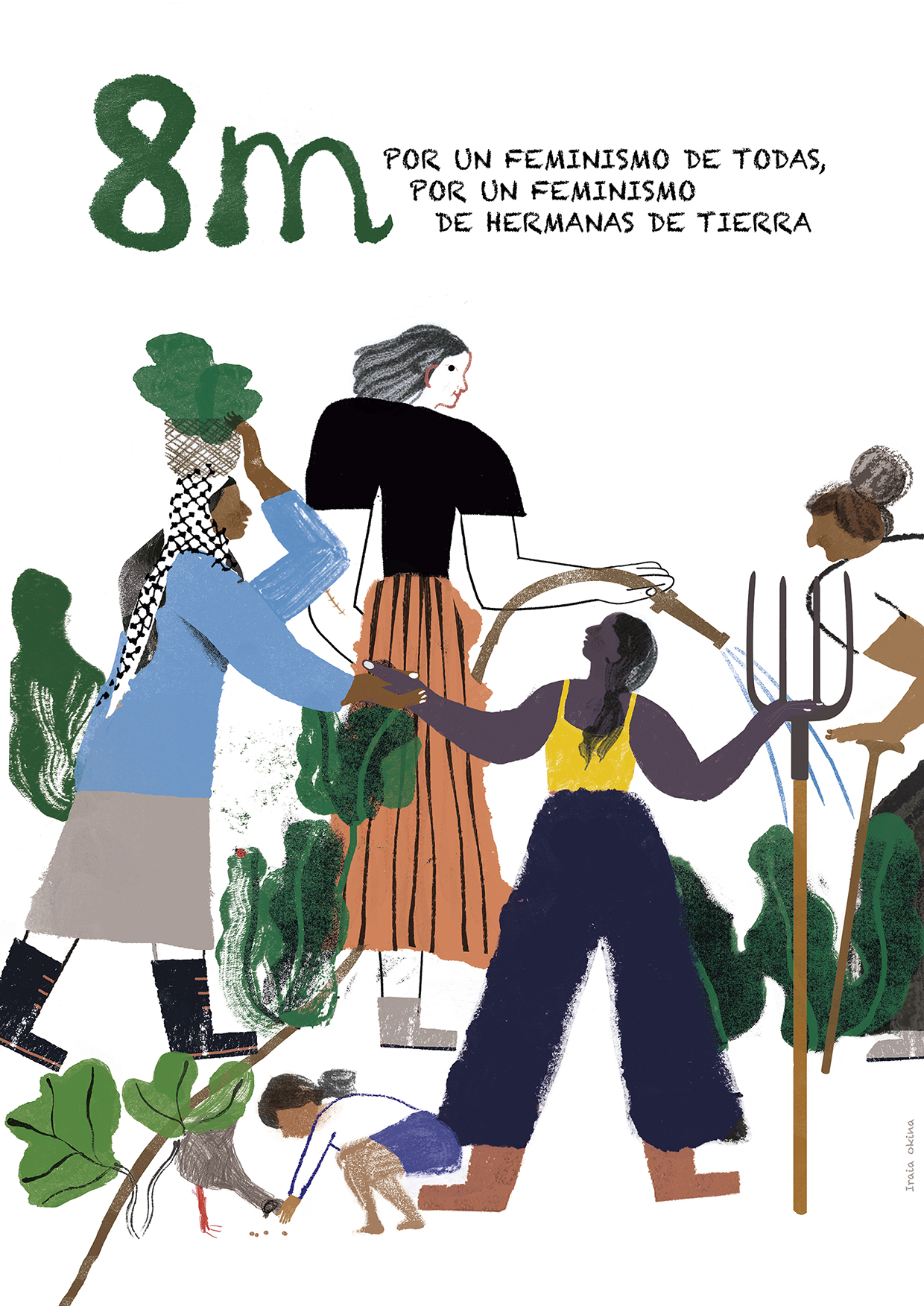
 Iraia Okina. Download it here.

This manifesto was translated into English by Becky Stoakes.

***(This manifesto was created through the collective work of Leire Milikua, Blanca Casares, Patricia Dopazo, Lareira Social, María Sánchez, María Montesino, Jornaleras de Huelva en Lucha, Lucía López Marco and Colectivo Arterra. Sisters of the land is a manifesto for the 8th of March, which was launched in 2018 by María Sánchez and Lucía López Marco.)

  • The poster is by Iraia Okina. Download it here
  • You can listen this manifesto here.
  • This manifesto was translated into English by Becky Stoakes.
  • This manifesto was created through the collective work of Leire Milikua, Blanca Casares, Patricia Dopazo, Lareira Social, María Sánchez, María Montesino, Jornaleras de Huelva en Lucha, Lucía López Marco and Colectivo Arterra. Sisters of the land is a manifesto for the 8th of March, which was launched in 2018 by María Sánchez and Lucía López Marco.
  • This manifesto is also available in the languages indicated below:
Sisters of the land: a feminist manifesto

Spring is in the air, and a seed is germinating and fighting to grow. On its own, it begins to make its way, breaking earth, little by little, following the rhythms of the sun, it will go on growing. But it needs water to sprout and grow. And if the water doesn’t reach it, it will fight to find it.

Sister,

we women,

like seeds, we too are making our own way. They seem invisible at first, but they grow with the strength of our voices in a place full of life where we never stop forging community through our hands and our words.

We are also part of the life of our villages: the lullaby, the root, the heartbeat. And like seeds which hook onto the wool of transhumant animals and germinate thousands and thousands of miles from their place of origin, we resist and we fight. And we look at those who went before us and we realise why we cannot afford to remain silent.

They say that the 8th of March belongs to all women.

But what is reflected in the media and on social networks doesn’t tend to correspond to this ideal, because we often fail to move beyond a superficial conceptualisation of ‘all women’, beyond cities, beyond recognising and celebrating women strictly from certain cultural backgrounds.

Where do we rural women fit in to this? How can we protect our place in society? How can we bring the unknown out of the shadows? How can we come to value hands that are hard at work but that, to many, continue to be invisible?

Rural women have suffered from double exclusion in this capitalist, technocratic and urban-centric society: for being women and for being from a rural area.

Rural women,

sisters of an only child, wives, daughters, sisters, granddaughters, nieces…

Always in the shadows, but taking all the strain. Owners of nothing, but responsible for everything.

It’s about time that we payed tribute to the work and the sweat of women like our grandmothers and our mothers, who worked the land so much and at the same time shouldered the burden of household work in the shadows, in complete and total silence.

We must name them one by one.

We must act as a loudspeaker so that their voices resound.

We must tell people that rural women were, are and will be in the future strong women of the land, who in most cases were not able to make their own choices or decisions; that by making sacrifices, growing up in homes built on foundations of inequality and sexism, they paved the way for other women.

And no,

we won’t forget today’s women who are unable to go on strike or attend the protest, even if they want to.

Because it’s we women who are the care-givers, tending to people, herds, crops, fields and forests. And, of course, we cannot forget all the female migrants, our colleagues, who work in precarious conditions, are abused and suffer sexism in our country. They suffer a triple discrimination: for being women, for being from a rural background, and for being migrants.

We are holding firm.

It’s high time we changed our perspective.

We have always been here, working the land, giving care, being the invisible but essential root that kept homes from collapsing, no matter how difficult things were for the women that came before us and of how difficult they still are.

No, we don’t need anyone to save us.

We want our place and we want to shout loudly: were are here, we were always here and we want to stay.

We don’t want the authorities to focus exclusively on satisfying the needs of cities; we need basic services too. We want to be able to decide whether to stay or leave. We women want to stop being second class citizens. We want food sovereignty, extensive livestock and agroecology. We want to build communities, to maintain them, to help one another, to feel acknowledged and supported.

We want to set an example for the girls of the future, for our daughters and granddaughters, for all of them. We want to tell them that this is their country too, that this culture full of animals, trees, land and people is also theirs, that this is where we come from and where we’re going. Because we don’t want to leave, because we think that other ways of life, other kinds of relationships and production are possible, beyond this exploitative system, and that our lifestyle has a great potential to teach and to nourish.

Auzolan in Basque,

a vecinal in Aragonese,

facendera in Leonese,

sestaferia in Asturian,

roga in Galician,

a tornallom in Valencian,

a cumuña in Cantabrian,

treball a jova in Catalan,

a vediau in Aranese…

Communal work, hands that give care and help. A natural way of working in the field or in rural areas that generally fed and gave life to our villages. Now, more than ever, we need to reclaim these regional words and, above all, bring their sentiments back to life. We have to keep forging networks in rural areas, share, talk, raise our voices, help other women, be part of the root and the branches.

Because our land isn’t empty, no matter how much you have tried to empty it.

Because we’re still here, alive and well.

Here’s to a feminism that belongs to all women,

here’s to the sisters of the land.

***

You can support this manifesto by signing here. Together we are better.

***

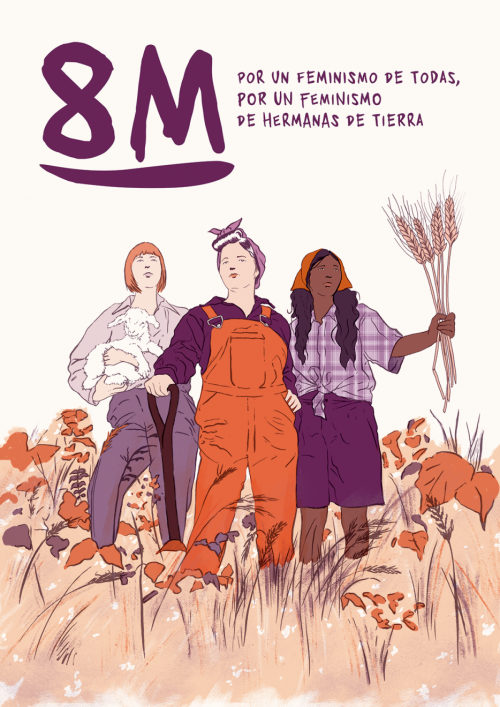
The illustration has been designed by Cristina Jiménez. You can download the printable version here.

(This Manifesto was written by Lucía López Marco and María Sánchez. Thanks to Patricia Dopazo, Anna Gomar, Blanca Ruibal and Elena Medel for your advice and notes. And thanks to the many women who have sent their contributions.)

Translated by Adam Williamson and Alfonso Moles

The day I adopted an olive tree

Article originally published in the blog of the SIMRA Project on 1st February 2018

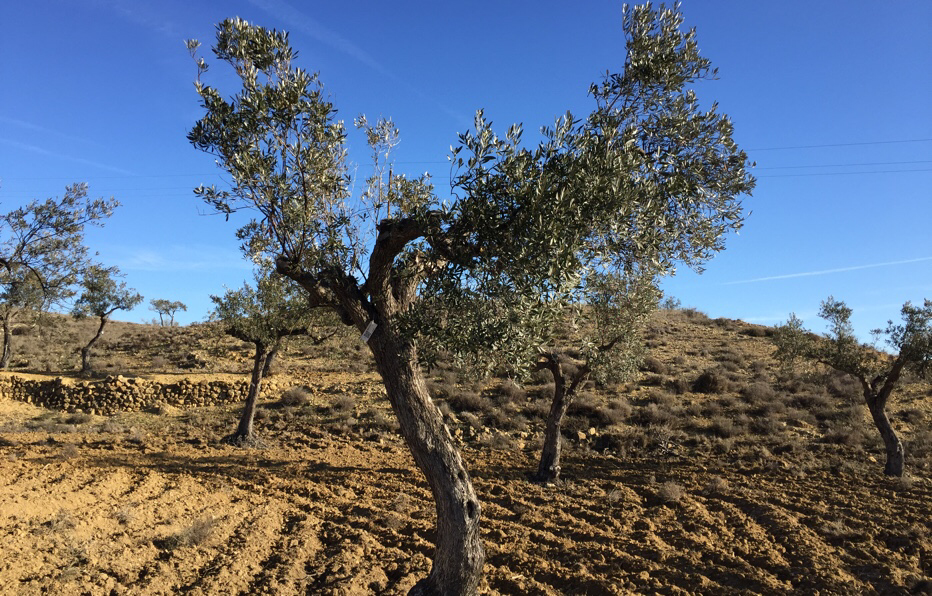
Carmen, the olive tree I have adopted. (Photo:  Apadrinaunolivo.org)

A year ago this week, I adopted an olive tree. I called it Carmen, after my grandmother. Whenever I want to know about my tree I just need to open an app that I have installed on my mobile phone. I can see pictures of it and whether it has been pruned, or what the local weather’s like, etc.… Once a year I receive two bottles of delicious olive oil. But what I love most, is that for only 50€ per year I am helping to employ people at risk of exclusion, I am helping young people to have a future in their village so they don’t have to migrate to the city, and I am preventing the closure of a local school in a village that, like so many others in inner Spain, have had to face the monsters of depopulation, ageing and loneliness. All at the same time as I am helping to recover hundred-year old olive trees and local traditions and conserve landscapes, care for the land, and support environmental, social and economic sustainability.

Read more

Partners’ Lands to restore Spanish abandoned forestry areas

Article originally published in SIMRA’s Project Blog on 1st September 2016

It was between 1855 and 1924 when the Spanish Government expropriated and auctioned the assets that belonged to the Catholic Church and the religious orders and the barren and communal lands of the municipalities. The principal aim of this confiscation was to get extra income to pay off the public debt securities that the state had issued to finance itself. Previously the owners of these assets used to pay very low or no taxes and with the change of their property the state could get more and better taxes.

ramoneo
Goats browsing in a forest area.

Most of the lands auctioned weren’t a good investment for potential buyers, because their profitability was going to be limited. However, they were essential for the survival of the nearest villages, because the neighbours had always used them for livestock farming, for getting timber and firewood, etc… So, their food (meat, milk and honey), their clothes (wool, furs and leather), their main energy source (firewood and coal) and the access to basic commodities for building (wood and stone) were at stake in an eminently farming rural system.

That is why, the neighbours, afraid of losing their livelihood, decided to get together and find enough money to access the auctions and acquire the land that sustained their way of living. These initiatives were very common in different parts of Spain and could be called Montes de Socios (Partners’ Lands), as a summary of the different local names: Monte de la Sociedad de Vecinos (Neighbours Association Lands), Montes del Común (Common Man’s Lands), Sociedad del Monte (Lands Partnership), Sociedad de Baldíos (Barren Lands Partnership), etc…

Over the years, many Spanish rural areas have been abandoned, including whole villages and their surroundings and even whole valleys. With the aim of recovering and promoting the Partners’ Lands social approach, and also to contribute to economic diversification, modernization and the improvement of the quality of life in rural areas, The Forestry Association of Soria has developed the project Montes de Socios (Partners’ Lands), funded by FEADER and The Spanish Ministry of Agriculture, Food and Environment.

To achieve this goal, they will follow three main actions: Making the Partners’ Lands known, implementing practical examples of renovation of the Partners’ Lands through the constitution of executive committees and putting forward a proposal for basic regulations to establish a specific legal framework for the Partners’ Lands.

Thanks to the Forestry Association of Soria, the Ley Básica de Montes 43/2003 (Basic Law of Lands 43/2003) was modified to allow the Management Boards (Juntas Gestoras) to take over the land management without the imperative to find and collaborate with all the owners’ heirs. This change has favoured the creation of many Management Boards throughout a growing number of provinces.

According to the researchers, in Spain there are at least 1.500.000 hectares of Partners’ Lands, and most of them are located in areas endangered by depopulation. Sometimes, innovating in marginalised rural areas means looking back to the past in order to move ahead to the future.

More information is available at www.montesdesocios.es